Disclosure: Some links may be affiliate links. This means that I may earn a small commission if you decide to buy (at no additional cost to you)
Last Updated on September 9, 2026 by Erin Donahue
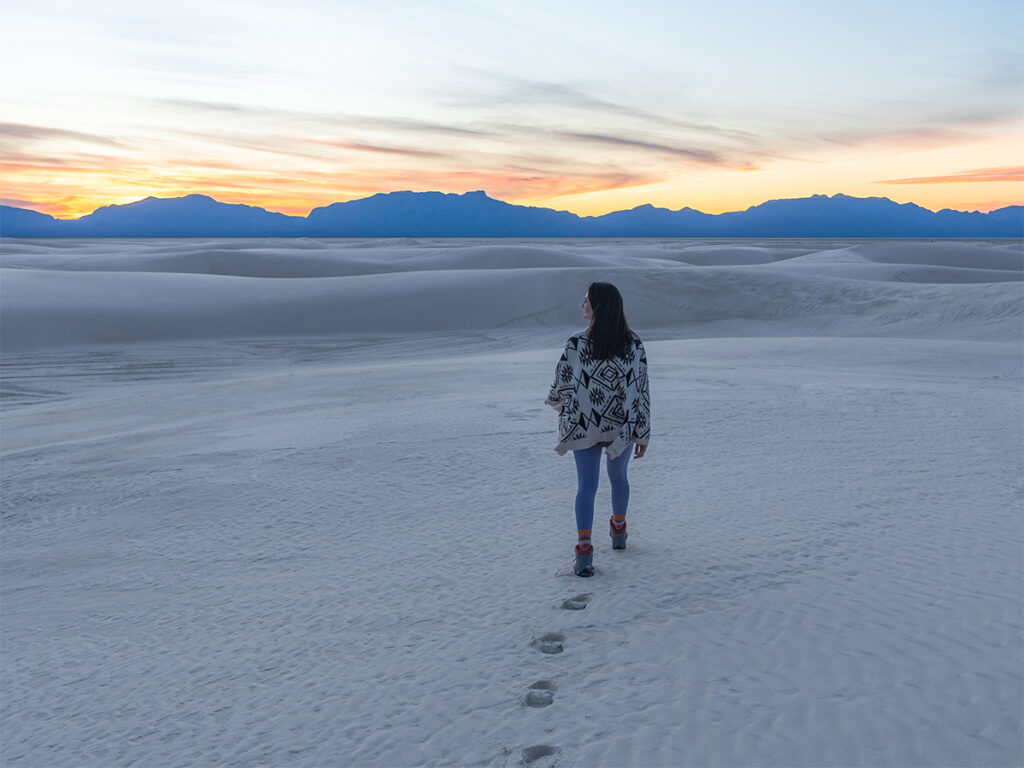
The rolling dunes of White Sands National Park offer photographers an otherworldly landscape. From pristine ripples in the sand to dramatic shadows cast by the sun, this unique destination presents endless opportunities for stunning imagery. Coincidentally, White Sands National Park is now my most visited U.S. National Park. It’s funny, I first traveled to New Mexico specifically to photograph the sunrise and sunset there, but have since returned numerous times as it’s only an hour away from my client, The Village of Ruidoso. In this guide, I’ll share essential tips to help you capture the essence of the largest gypsum dune field in the world.
What Is White Sands National Park?
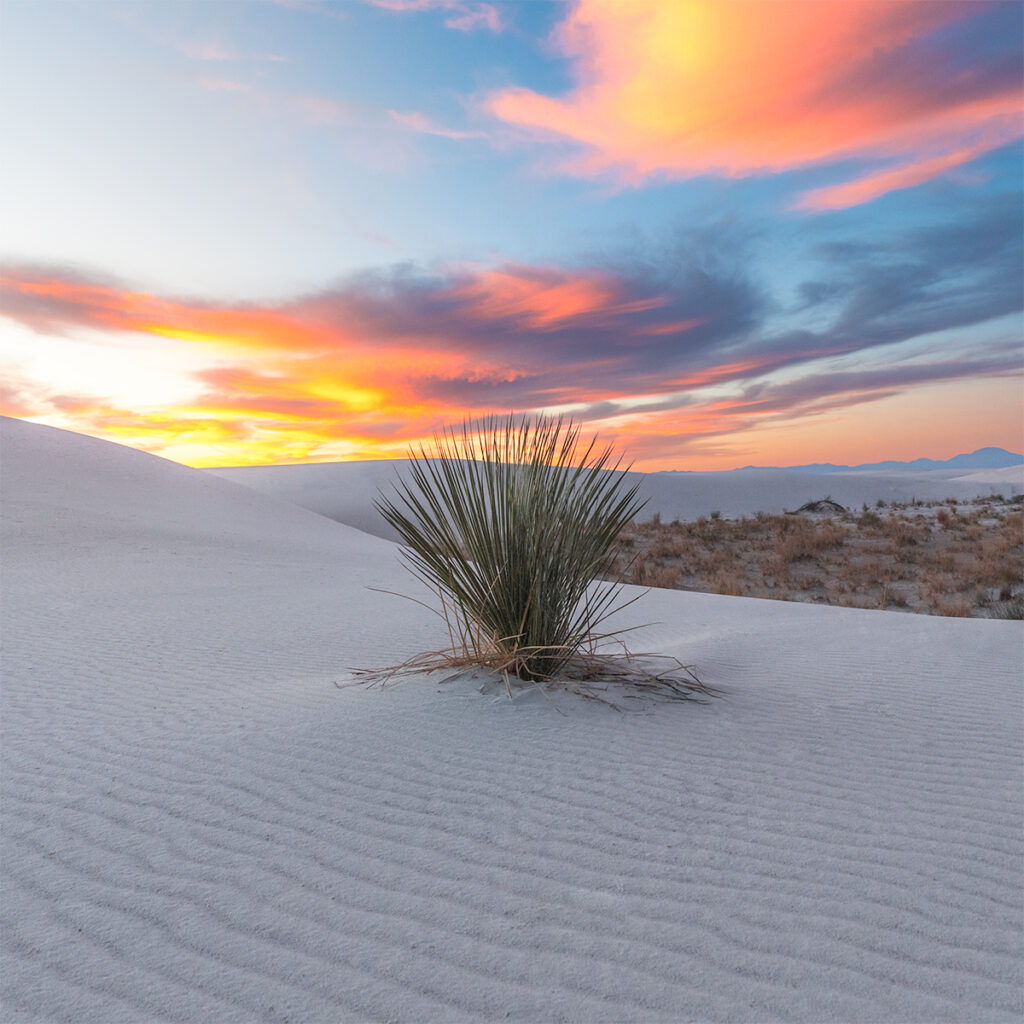
Home to the world’s largest gypsum dune field, this natural wonder creates an otherworldly ecosystem where waves of pure white sand stretch as far as the eye can see. Unlike typical dunes made of quartz, these are composed of gypsum crystals, a mineral rarely found in sand form due to its water-soluble nature. The unique geological conditions of the Tularosa Basin allow these remarkable dunes to exist and persist.
The park’s history is as fascinating as its landscape. Originally protected as a National Monument in 1933, it achieved National Park status in December 2019, marking its significance in America’s natural heritage. The dunes exist in a complex ecosystem where wildlife has adapted uniquely to the white environment – some species have even evolved lighter colorations to blend with the sand.
Best Times to Visit White Sands National Park
If you’re wondering about the best time of day to visit White Sands National Park, the quality of light can result in drastically different photos depending on when you go.
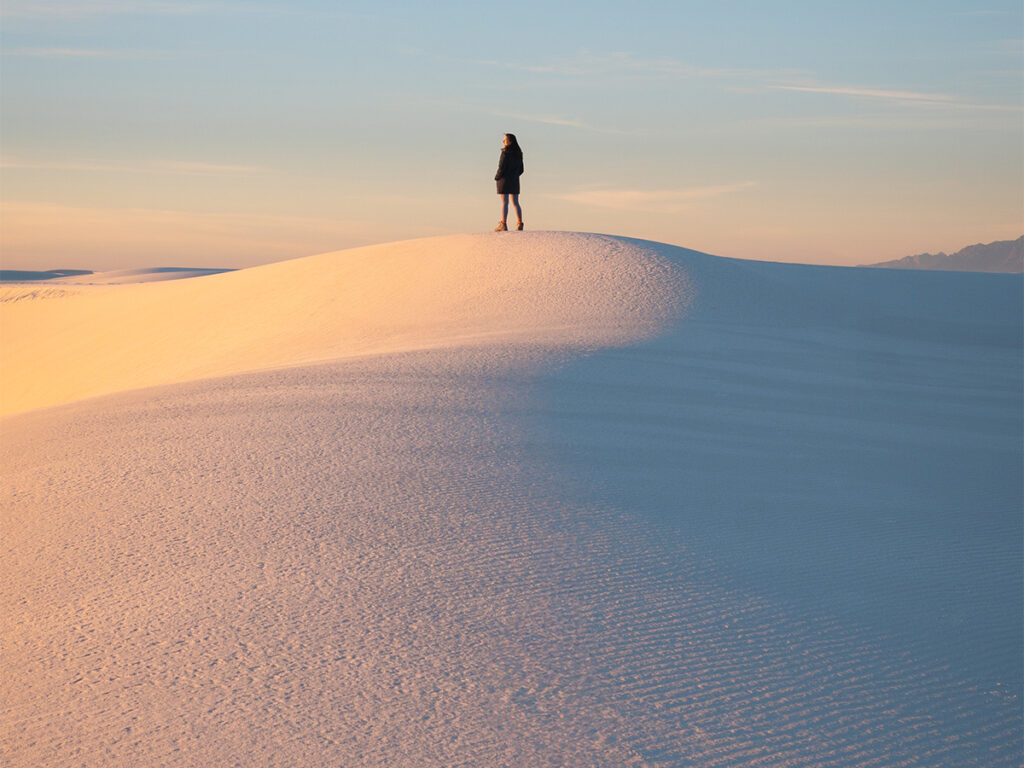
- Golden Hour & Blue Hour: Plan to arrive 1-2 hours before sunset or sunrise. The low-angle light creates dramatic shadows across the dunes and brings out their texture. The white gypsum sand takes on beautiful golden and blue hues during these times.
- Mid-Day: While challenging, mid-day offers unique opportunities for photographers who know how to work with high-contrast conditions. The stark white sand against blue skies can create striking minimalist compositions. Use a polarizing filter to deepen the sky’s blue and enhance cloud definition. Look for abstract patterns formed by harsh shadows, or experiment with black and white photography where the strong contrast becomes an artistic advantage.
- Season Selection: The Summer Monsoon Season (July-September) creates dramatic opportunities for storm photography, with lightning strikes illuminating the white dunes and massive thunderheads providing spectacular backdrops. However, photographing during monsoon season comes with serious risks:
- Lightning strikes are extremely dangerous in the open dunes
- Flash flooding can occur with little warning
- Storms can develop rapidly and unexpectedly
- Cell phone reception may be limited or nonexistent in parts of the park
- SAFETY WARNING: Storm photography at White Sands should only be attempted by experienced storm chasers who understand weather patterns and have appropriate safety equipment. Always check weather forecasts, inform others of your plans, and maintain multiple evacuation routes. If you hear thunder or see lightning, seek shelter immediately. No photograph is worth risking your life!!
Essential Camera Gear for Photographing White Sands National Park
As always, you can find all the camera gear I travel with, but this is the general list of what you should keep in mind to bring.
- Camera Body: Any modern digital or mirrorless camera will work, even your camera phone. However, full-frame sensors offer advantages for handling dynamic range.
- Lenses:
- Filters:
- Circular polarizer (CPL) to manage glare and enhance sky contrast.
- Neutral density (ND) for long exposures.
- Travel Tripod: an essential for travel gear. periodt.
- Cleaning Kit: The fine gypsum sand gets literally everywhere.
Exposure Settings & Post-Processing Tips for White Sands National Park

- Base ISO: Keep it low (100-200) to maintain detail without noise
- Aperture: f/8 to f/11 for optimal landscape sharpness and depth of field
- Exposure Compensation: Start at +1 to +1.5 EV to account for the bright sand
- White Balance: The white sand provides a perfect reference for accurate color
- Highlight Recovery: Shoot RAW to maintain detail in bright areas
- Local Adjustments: Use graduated filters for skies and dodge/burn to enhance dune textures
White Sands National Park Composition Photography Tips
- Leading Lines: Use ripples in the sand and dune crests to guide viewers through the frame
- Scale: Include people, plants, or other elements to convey the massive scale of the dunes
- Patterns: Look for repetitive patterns in the sand ripples
- Minimalism: Embrace negative space and simple compositions
- Foreground Interest: Use yucca plants, footprints, or interesting sand patterns
Practical Tips for Visiting White Sands National Park
- Park Access: Check park hours at NPS. Unlike many national parks, there are opening and closing times
- Navigation: Save GPS coordinates of your shooting locations and download an offline map
- Physical Preparation: Bring water, sun protection, and comfortable shoes
- Weather Watch: Monitor forecasts for clouds and wind conditions
- Sand Protection: Consider using a cover or plastic bags
FAQ About Photographing White Sands National Park
The gypsum sand is so bright and reflective that your camera’s automatic metering reads the scene as overexposed and underexposes it in response. Start at +1 to +1.5 EV exposure compensation to correct for it.
Golden hour and blue hour give you the most dramatic light and shadow across the dunes. Midday works too if you want high-contrast, minimalist compositions.
A mid-range zoom for landscapes, a telephoto for compressed dune compositions, a circular polarizer, an ND filter for long exposures, and a tripod cover the basics. Even a phone camera can work well here.

Great Post. Thanks for the information.
-Sunny
A.C.E. Expeditions