Disclosure: Some links may be affiliate links. This means that I may earn a small commission if you decide to buy (at no additional cost to you)
Last Updated on September 11, 2026 by Erin Donahue

Far from Taiwan’s usual highlights of night markets and Taipei 101, nestled in the southwestern part of the island, lies one of its least understood natural phenomena: the Purple Crow Butterfly migration in Maolin National Scenic Area (茂林國家風景區).
I first traveled to Maolin after my mom mentioned it to me almost in passing, knowing how invested I am in showcasing Taiwan beyond Taipei. It’s a bit of a journey from Hsinchu, where I’m based, but that’s part of why I wanted to go. I was surprised that something so significant barely registered on international itineraries, and even more surprised to learn that most Taiwanese people had never heard of it either.
My first visit didn’t go as planned, though. Cloudy skies in January kept the butterflies dormant, and the valley felt suspended in stillness. Instead of accepting defeat, I returned to southern Taiwan just ten months later in November, under sunny skies when temperatures across most of the island are at their most comfortable. The difference was immediate.
It took standing in Maolin to understand why Taiwan is nicknamed the Kingdom of Butterflies.
The Purple Crow Butterfly
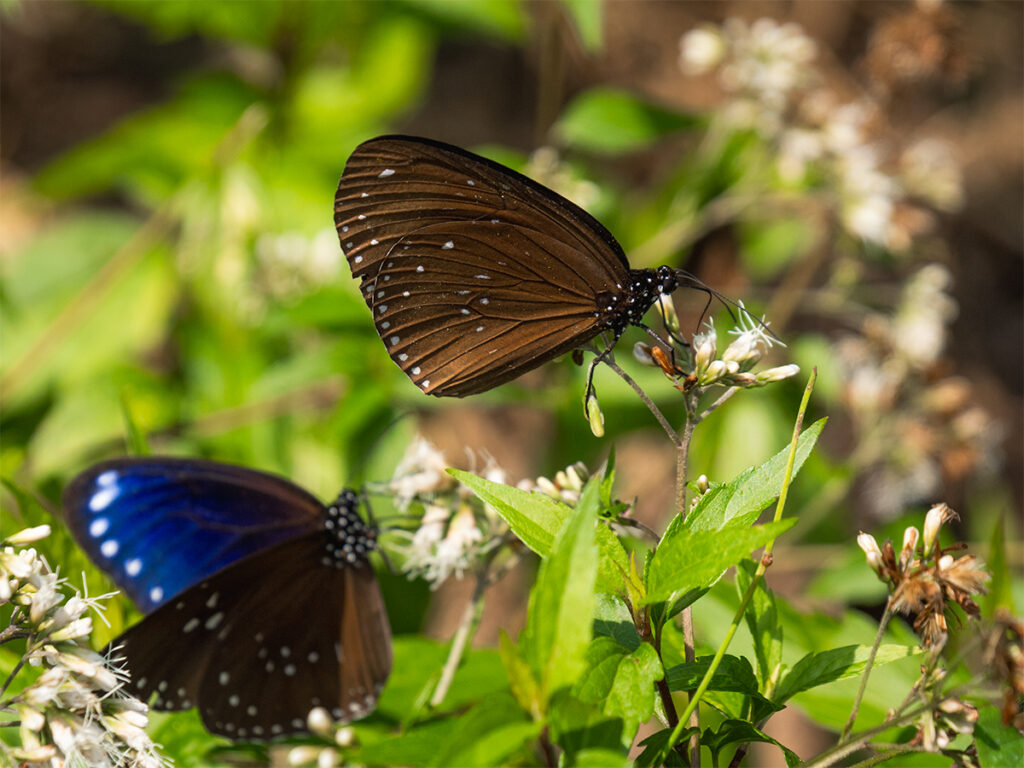
The Purple Crow Butterfly isn’t actually a single species. It’s a collective name for four butterfly species in the genus Euploea found in Taiwan: the Striped Blue Crow (Euploea mulciber basine), the Blue-Branded King Crow (Euploea eunice hobsoni), the Double-Branded Crow (Euploea sylvester swinhoei), and the Dwarf Crow (Euploea tulliolus koxinga). All four belong to the “crows and tigers” group of brush-footed butterflies.
The name comes from how their wings catch the light. Their wings are covered in scales that reflect sunlight differently depending on the angle, shifting between pale purple, bright purple, and bright blue, something Japanese entomologists have poetically called “magic light.” A fifth species, the Juvia Large Crow, once existed too, but it went extinct in the 1960s after coastal development destroyed its mangrove forest habitat, making it the first butterfly species known to disappear from Taiwan entirely.
Each year, the butterflies complete three mass migrations. Around the Qingming Festival in March and April, they move north from the southern valleys. By May or June, near the Dragon Boat Festival, they disperse to breed without a single fixed direction. Then in September and October, over one million make the journey south toward Maolin’s sheltered valleys to overwinter. The crossing is significant enough that highways along the route get protective netting installed, and officials track numbers and restrict traffic at its peak. That’s how consequential they are!
Why Taiwan Earned the Nickname
One of Taiwan’s nicknames, the “Kingdom of Butterflies,” comes from being home to 55 endemic species, and Maolin plays a critical role in sustaining that biodiversity. Interestingly, the larvae of Purple Crow Butterflies feed on poisonous plants, and the toxins carry into adulthood, making the butterflies unpalatable to predators.
About Maolin National Scenic Area (茂林國家風景區)
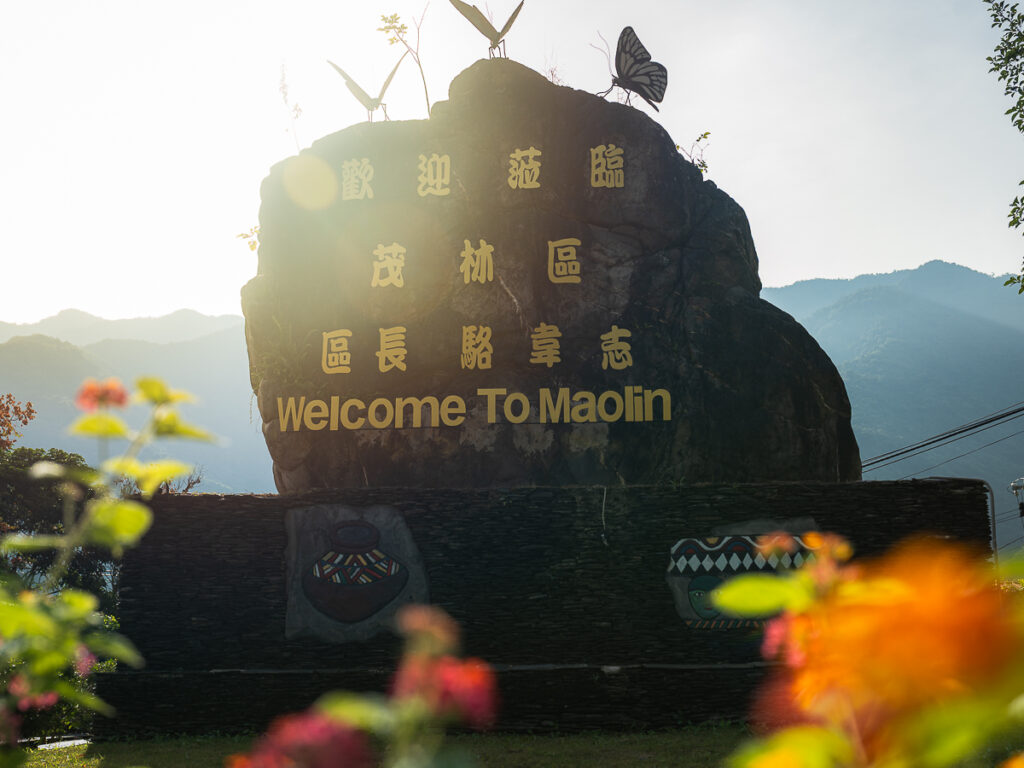
Maolin National Scenic Area spans roughly 960 square kilometers in the western foothills of Taiwan’s Central Mountain Range, with elevations ranging from 230 to 2,700 meters. It covers Kaohsiung’s Maolin and Liugui districts along with part of Sandimen Township in neighboring Pingtung County. Three major rivers, including the Laonong and Zhuokou, cut through the terrain.
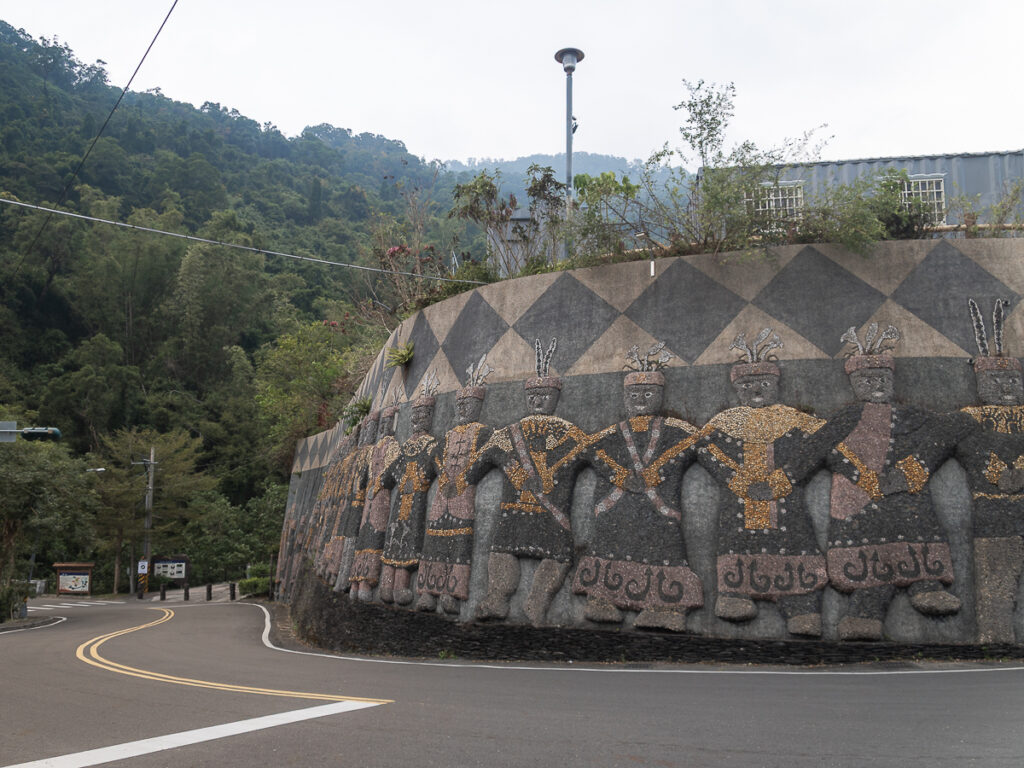
The Rukai people, one of Taiwan’s Indigenous groups, are known for their slate houses and beadwork. They consider Purple Butterfly Valley (紫蝶幽谷) part of their heritage, passed down through generations. Their imagery appears throughout Maolin, including a long pebble-mosaic wall near the scenic center depicting figures in traditional dress.
When driving in and out of the scenic center, you’ll cross over a bridge with arches shaped like open butterfly wings. Inside the visitor center, you can sit in a small theater-style room for a five-minute visual presentation before heading out toward the sanctuary trails.
Where to See Butterfly Migration in Taiwan
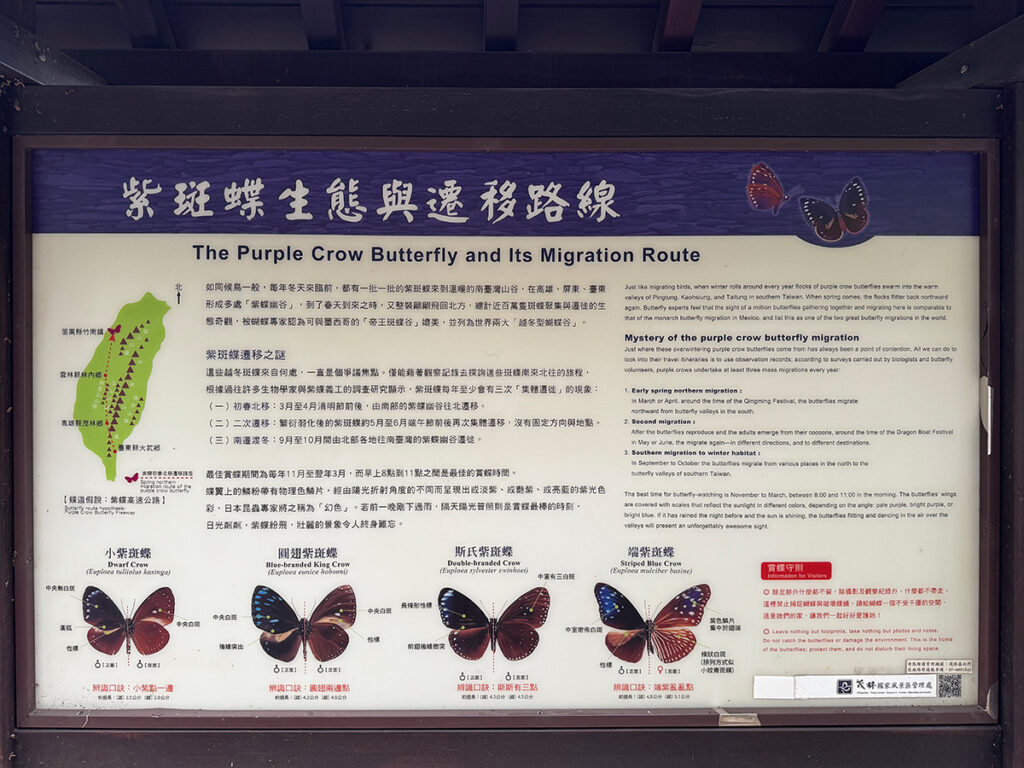
If you’re wondering where to see butterfly migration in Taiwan, Maolin Ecological Park, within Maolin National Scenic Area, is the most reliable and well-protected place to do so. Each winter, its sheltered valley hosts one of only two great wintering-type butterfly migrations in the world.
Every year, from November through March, thousands of Purple Crow Butterflies (Euploea species) migrate to Maolin’s valleys to overwinter. During peak conditions, the forested slopes fill with clusters of dark brown and purple wings. While Mexico’s Monarch migration receives far more international attention, Maolin’s phenomenon is just as remarkable, more mysterious, and far less crowded.
The park itself is smaller than it looks on a map. It’s easy to walk the whole trail in a single visit, but sightings can still vary by exact location. On my second trip, staff at the visitor center pointed me toward a specific stretch of trail that ended up being far better for photographing the butterflies than the spots I’d previously checked. For the most direct way to find the butterfly clusters, ask the visitor center before walking the trail.
Best Time and Conditions to Visit Maolin National Scenic Area
For nature and wildlife enthusiasts, the best time of year to see the Purple Crow Butterfly migration in Maolin National Scenic Area is November through March, and in the mornings. Weather plays a decisive role in whether you’ll actually see them. On cloudy, windy, or rainy days, the butterflies remain clustered and inactive. Something I experienced firsthand during my first visit in January. However, if it rains the night before and the next morning is sunny, that combination tends to bring out the most activity.
November is one of the best months to travel in Taiwan overall. If seeing the butterfly migration is one of your primary goals for visiting Taiwan, a trip to Maolin should be planned as a flexible stop. At a minimum, I recommend at least two days allocated to the Maolin area.
Butterfly Behavior: Active vs. Clustering
Like a lot of things I do around photography, location scouting usually requires more than one visit. What changed between my first and second trip was understanding the butterflies’ behavior, not just the weather.
On the second visit, I arrived earlier and stayed longer. The valley was quiet enough that I could hear other visitors’ voices carry across the path. The trail itself is hilly, and I moved with purpose, scanning the trees for clusters. Instead of hanging in dense curtains like I’d hoped to capture, they flitted constantly through the air.
Biennial Butterfly Beauty Festival (雙年賞蝶季)
Maolin also hosts the Biennial Butterfly Beauty Festival during migration season. Past editions have included a monthly market featuring Indigenous craft vendors and local farmers, along with family-friendly butterfly-viewing programs. I haven’t attended it myself, so I can’t speak to it firsthand, but check the official Maolin website for the most current information.
How to Get to Maolin National Scenic Area

Maolin National Scenic Area is located about 90 minutes from Kaohsiung City. These are essentially the only options for getting there:
By Car (Recommended): Hiring a driver or renting your own car (or moped) gives you the most flexibility to explore the area. Typically, when I travel outside the cities, I hire a private driver. I’ve used the same driver on trips outside of Kaohsiung, Nantou County, and Kenting. My mom, who is Taiwanese, isn’t comfortable with us renting a car and driving ourselves because of all the accidents with moped drivers, so she prefers hiring a private driver.
By Public Transportation: Bus services run from Kaohsiung to the Maolin area, but schedules may be limited. Check the official Maolin National Scenic Area website or Kaohsiung’s public transportation information for the most current bus routes and timetables. Be sure to plan your return trip carefully, as service may be infrequent.
Guided Tours: Several tour operators in Kaohsiung offer multi-day trips to the Maolin National Scenic Area. This option provides transportation but offers less flexibility than having your own vehicle. That matters if you need to adjust your schedule around weather or butterfly activity.
Taiwan is The Kingdom of Butterflies
My journey to Maolin National Scenic Area was the primary driver for returning to southern Taiwan. This section of the island offers a glimpse into both natural wonders and cultural heritage that few people experience. Despite its ecological importance, Maolin National Scenic Area remains largely unknown, even among local Taiwanese. Most travelers to Taiwan only visit Taipei. Some might venture further to Sun Moon Lake and maybe Kenting or Hualien’s Taroko Gorge in the summer, but Maolin continues to fly under the radar.
That invisibility is both Maolin’s protection and its risk. Fewer visitors mean fewer disturbances, but also less awareness. On my second visit, I watched a child grab at the butterflies with no regard. Touching their wings, even lightly, damages the scales that let them fly, and it kills them almost instantly. The child’s mother stood right next to him, encouraging him, which infuriated me. I said something, of course, but the moment stuck with me because it was the obvious representation of the dangers of overtourism. A place this quiet and this fragile only stays that way if people treat it with care. My writing this page and leaving a paper trail could put this sanctuary in jeopardy.
Maolin Remains One of Taiwan’s Hidden Gems
If you’re planning a trip to Taiwan and want to venture beyond the usual highlights, consider adding Maolin National Scenic Area to your itinerary. Whether you’re there to witness the Purple Crow Butterfly migration, hike through its scenic trails, or learn about Taiwan’s indigenous cultures, Maolin offers experiences that showcase the island’s remarkable diversity. Just remember to allow enough time, respect nature, and check weather forecasts if you’re hoping to see the butterflies.
FAQ About Purple Crow Butterfly Migration in Maolin National Scenic Area
Why is Taiwan called the Kingdom of Butterflies?
Taiwan is home to 55 endemic butterfly species, and large-scale migrations like the Purple Crow Butterfly migration in Maolin have contributed to its nickname as the Kingdom of Butterflies.
When is the best time to see the Purple Crow Butterfly migration in Taiwan?
The best time to see the Purple Crow Butterfly migration is from November through March, with clear, sunny mornings between 8–11 am offering the most activity.
Where is the best place to see butterfly migration in Taiwan?
Maolin Ecological Park, within Maolin National Scenic Area, is the most reliable and well-protected place to see butterfly migration in Taiwan, home to one of only two great wintering-type butterfly migrations in the world.
Do the Purple Crow Butterflies appear every day during migration season?
Purple Crow Butterfly activity depends heavily on the weather. On cloudy, windy, or rainy days, butterflies remain clustered and inactive. The best activity tends to follow rain. If it rained the night before and the morning is sunny, that combination often brings out the most movement.
How much time should I plan for Maolin National Scenic Area?
Plan at least two days in the Maolin area to allow flexibility for weather conditions, especially if seeing the butterfly migration is a priority.
Is Maolin National Scenic Area easy to reach from Kaohsiung?
Maolin is about a 90-minute drive from Kaohsiung City. Visiting by car or private driver offers the most flexibility, while public transportation is possible but limited.

Comments +